How Clinical Trial Site Selection Actually Works in India
22 October 2026 · 3 min read
We assumed site selection was simple. A sponsor has a study, needs doctors and hospitals who can run it, searches a database, sends out emails and then finally picks the best sites.
The people we spoke to described something more layered.
The information teams rely on is usually scattered across several places. It goes stale quickly, takes a lot of time to maintain, and it is often hard to tell when it was last updated. No single source feels enough. Pieced together, they are how a trial finds its sites.
What teams look for in a clinical trial site
Finding a hospital is not the same as finding a clinical trial site. A hospital may be well known and experienced in research, and still not be the right fit for a particular study. In practice, a few things can get in the way:
- The relevant doctor may have moved on.
- The department may already be at capacity.
- The hospital may not see enough of the right patients.
- The research team may not be taking on new studies right now.
Then there are the study’s own requirements. A cancer trial might need patients at a specific point in treatment, the right testing and imaging facilities, and a team trained in Good Clinical Practice (GCP) that can follow the protocol closely. A skin-condition study might point to entirely different sites.
The goal is not to find the biggest list. It is to find the handful of sites where the study has a real chance of working.
Where clinical trial teams actually look
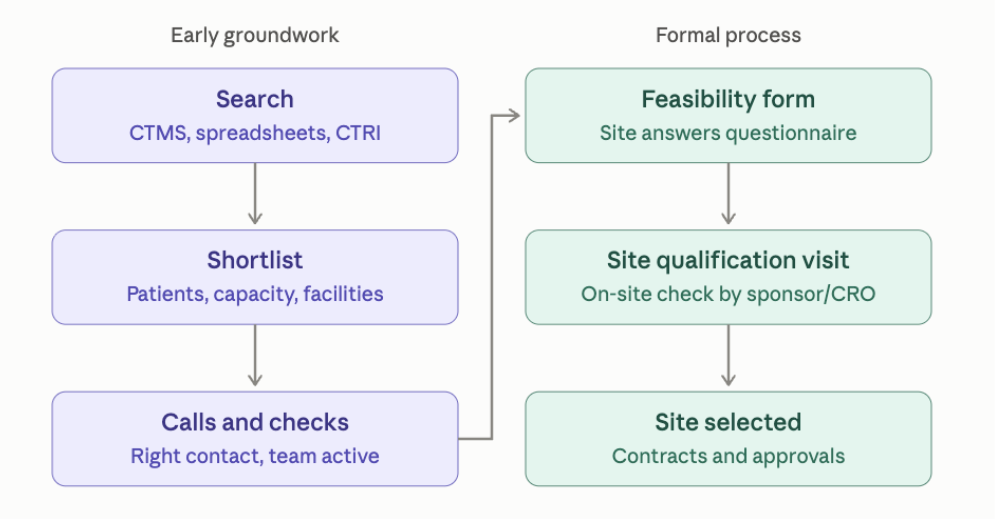
For teams that have run trials before, the CTMS is one of the first places to look, along with internal Excel sheets and CTRI. Between them, they hold records of doctors and hospitals the organisation has worked with, or that have run similar trials.
Each gets a team part of the way. A record shows that a doctor worked on a study. It may not show whether they are still at that hospital, whether that study resembles this one, or who the right contact is today.
So teams also draw on old study files, colleagues, coordinators, SMOs and doctors who know other doctors. This is how information in the field has built up over the years, across many people and organisations.
Calls, forms and visits
The final decision on a site usually rests on two things: a completed feasibility form, where the site answers detailed questions about its patients, staff and facilities, and a site qualification visit (SQV), where the sponsor or CRO assesses the site in person.
But by the time the feasibility form is sent, someone has usually done a good amount of filtering already. Much of it happens over quick calls, which answer what no registry can: Is this still the right person? Is the team active? Is this study worth sending across?
Through these conversations, a CRA may learn that one doctor has the right patient pool but is busy with a competing study, that another hospital is a good fit but slow to start a new trial, that a third has the facilities but a coordinator shortage, or that a fourth is a strong option because the team has worked with them before.
What is learned along the way rarely lives in one place. It sits in email threads, spreadsheets or with the coordinator who handled the last study.
This early work matters. It decides whether a team starts with a useful conversation or spends weeks chasing old names.
Why we are writing about this
While researching, we found that much of this work is not visible from the outside. Public registries show that a trial happened. They do not show how someone decided whom to call, what was learned in the first conversation, or why one hospital was chosen over another.
That is the part we want to document in our upcoming pieces.
In the next piece, we look at where these names and fragments come from in the first place, and why even a well organised CTMS or CTRI rarely gives a team the full picture on its own.